


Fort of janjira story Janjira Height of the fort 0 Types of forts Jaldurg Dongarrang:
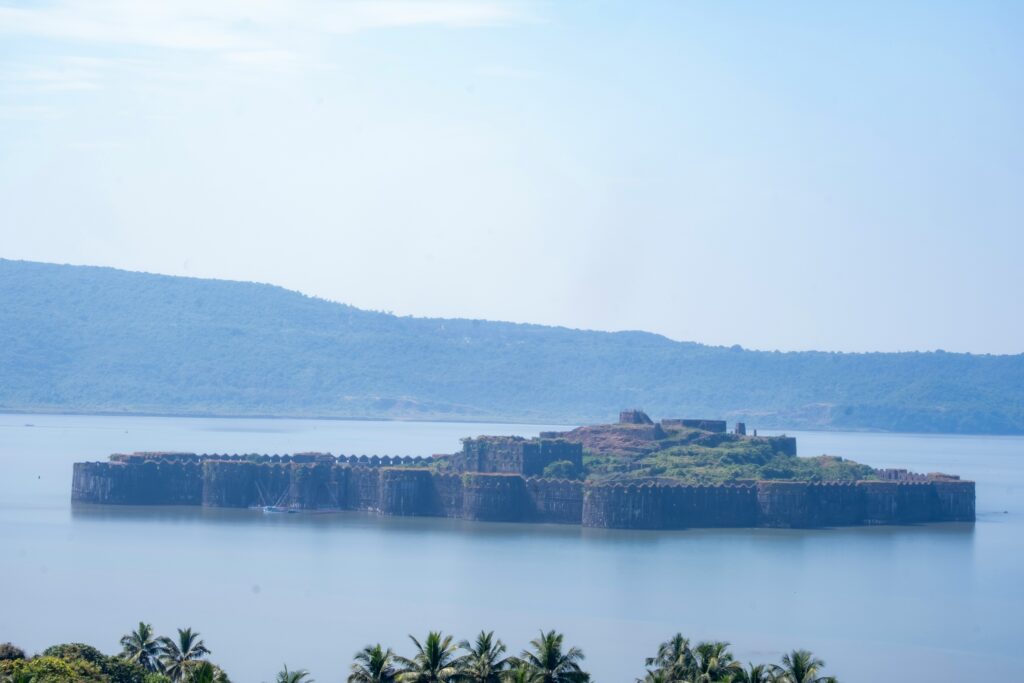
Fort of janjira story Raigad District Raigad The range quickly reaches Maharashtra about 750 km. The length of the beach is gained. Seeing the forts on this beach is a different kind of pleasure. This wandering continues from Rewas port and ends at Terekhol. Surrounded by seawater in Murud taluka of Raigad district, this invincible fort stands strategically at the mouth of Rajapuri creek.
Fort of janjira Story:
Janjira fort itself was known as ‘Fort Mehrab aka Fort Janjira.’ Etc. C. Malik Ahmad Nizamshah died in 1508. His 7-year-old son Bu-than Nizamshah came to the throne.
Mirza Ali and Kalb Alli, two Nizamshahi chiefs, came to Dandarajpur in North Konkan. At the same time, the sea urchins were bothering the spiders, so they built a wooden sheepskin on the creek of Rajpuri. Rampal’s spider was executed all over the area at that time. The Nizamshah sent a chief named Piramkhan to remove Rampatil’s thorn. Piramkhana set sail around Medhekot and made Rampatila unconscious, and took possession of Medhekot.
Rampal was sent to Nizamshah and converted. After his reign from 1526 to 1332, Piram Khan died in 1532 and was appointed Bu-than Nizamshah. Later, in 1567, on the orders of Husain Nizam Shah, he started building stone coats instead of wooden sheep coats. This work was completed by 1571 AD, and this stone fort came to be known as ‘Fort Mehrub.’
Later, in 1857, Alarg Khan was posted here. After he died in 1612, his son Ibrahim Khan was appointed. After his death, Siddhi Surudkhan became Thanedar in the period 1618-1620. After this, till about 1947, 20 Siddhi Nawabs claimed Janjira fort. As the income and expenditure from the Murud area did not match, Malik Amber broke the canal and established new barons here. Siddhi Ambersanak took over the responsibility of the channel. Of course, the founder of this Janjira Sansthan was Siddhi Ambersanak. Malik Amber died in 1625. Janjirekar had become an independent ruler.
20 Siddhis ruled for 330 years, and in 1948 the Janjira Sansthan was merged into the Indian Union. Done. In 1648, Shivaraya conquered Talegad, Ghosalgad and Raigad. In 1657, he conquered Jawali and turned his attention to North Konkan. Shivaya had realized that he would not dominate North Konkan without taking control of Fort Janjira.In 1659, Shivaraya sent Shamraj Pant and Baji Gholap to take Janjira, but this first attempt failed. Again in 1659, Nilojipant Raghunath Mujumdar Mayaji Bhatkar challenged Janjira’s achievement, but again, this attempt failed. The description of the third invasion is given in Sabhasad Bakhar as follows. The Rajyas sent Vyankoji Dutto Faujeni with Namjad.
Three hundred Negroes killed Vyankojipant and killed the horses. Vyankojipant did a lot. Twelve wounds were inflicted on Vyankojipant. Shirdi started a relationship with Salya. This was the third invasion of Janji. In July 1678, Shivaraya made a failed attempt to invade Janji. In 1682, Sambhaji Raja sent Dadaji Raghunath to take Janjira, but at the same time, Aurangzeb descended to the south, and his attempt to take Janjira was unsuccessful.
Janjira Sansthan, which was invincible during the reign of Siddhi Muhammad Khan, the last ruler of this Sansthan, merged with the Indian Sansthan on 3 April 1948. Places to see on the fort: The boat coming from Rajapuri village stops at the foot of Janjira fort. The Parsi inscription on the white stone at the entrance is clear. Carvings of a specific sort of stone can be found on both sides of the door. This is known as the sculpture of Gajant Lakshmi.
Between the two doors are the porches of the guards. There is a town hall at the entrance of Janjira fort. The cannons are placed on the fort in front of the fort as the footsteps go up to the fort, the largest of which is called ‘Kaladbangadi.’
After entering through the main gate of Pir Panchayat fort, there is another gate on the left side. On the right is a room-like construction. This is called Pir Panchayat. There are 5 Pirs in this building. There are some structures in the courtyard of this panchayat. This is where the three plows of the ship lie in a rusty state.
Horse Wagons Horse Wagons are worn as you proceed from the bank towards the front of the Peer Panchayat. When you come out of Surulkhana’s mansion, you can see a three-story dilapidated building in front of it. This is called Surulkhana’s mansion. The castle has fallen into decay over time.
To the north of the castle is a beautifully constructed hexagonal freshwater lake. This lake is about 20 m in diameter. There are four tanks in the four corners. Sadar: Behind Balekilla is the Chung building. This is called Sadar. Balekilla Balekilla is reached when you go a little higher with the feet built along the side of the lake. Today there is a flag raised for worship.
West Gate: To the west of the fort, just below the rampart, there is a small gate to get out of the rampart; this is called Darya Darwaza. It was used to get out in times of crisis. There was a prison near the ramparts just above the gate. The fort has 22 independent bastions. They are still intact today. It takes three hours to see all the defenses.
The best way to get to Janjira Fort is to take this route.
- Via Alibag:
If you want to see Janjira Fort, you can reach Alibag via Pune Mumbai. From Alibag, Murud can be reached via Revdanda. Boat service is available from Murud village to the fort. It takes half an hour to reach the fort from Kina.
- Pali Roha
Nagothane Salav can be reached via Nandgaon via Alibag via Pali Roha Nagothane Salav Nandgaon via Murmurud.
- By Dighi:
If you want to come from Konkan, you have to reach Mahad Goregaon Mhasle Borlipchantan Dighi. Boat service is available from Dighi to see the fort. Accommodation Murud can be accommodated in the village. Meals are available in the village. Water supply: Not on the fort Travel time: Half an hour from Murud village.