


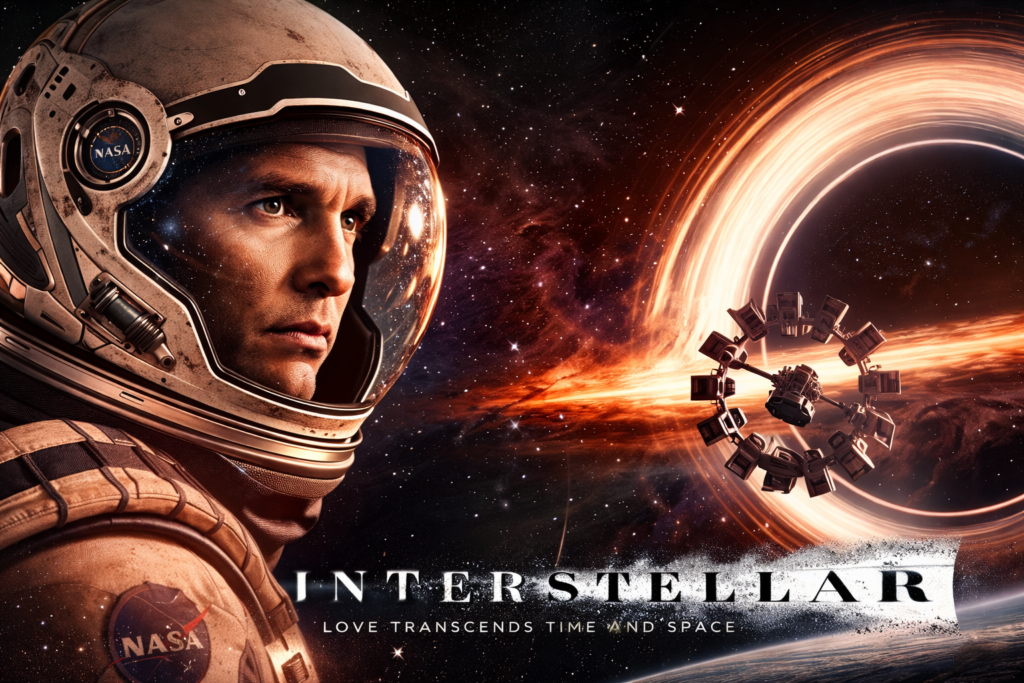
Interstellar Movie Explained: Story, Time Dilation & Ending Breakdown
There are movies you enjoy… and then there are movies that change the way you see the universe. Interstellar is one of those rare cinematic experiences that doesn’t just stay on the screen—it stays in your mind, your thoughts, and your emotions long after it ends.
I still remember the first time I watched Interstellar. It wasn’t just a movie night—it felt like a journey. A journey through space, time, love, and the unknown.
And honestly, I wasn’t prepared for how deeply it would affect me.
The Beginning: A Dying Earth
The story starts on Earth—but not the Earth we know.
Crops are failing. Dust storms are everywhere. Humanity is slowly running out of time.
In this world, we meet Cooper, played by Matthew McConaughey, a former NASA pilot turned farmer. He’s not just a man trying to survive—he’s a father trying to protect his children.
And that’s where the emotional core of Interstellar begins.
Because this isn’t just a space movie.
It’s a story about a father and his daughter.
The Mission: Hope Beyond the Stars
Cooper is recruited by a secret NASA mission led by Michael Caine. The goal is simple—but impossible:
Find a new home for humanity.
Through a mysterious wormhole near Saturn, a team of astronauts travels to distant galaxies in search of habitable planets.
This is where Interstellar shifts from a grounded survival story to an epic space journey.
But even as the visuals expand, the emotions stay personal.
Because every step Cooper takes into space is a step away from his daughter, Murph.
The Science That Feels Real
One of the reasons Interstellar stands out is its scientific depth. The film was guided by physicist Kip Thorne, ensuring that concepts like black holes and time dilation are portrayed as accurately as possible.
And this is where one of the most famous questions comes in:
Why is 1 Hour 7 Years in Interstellar?
This concept comes from something called time dilation, a real scientific theory from Einstein’s Theory of Relativity.
In the film, the crew lands on a planet near a massive black hole called Gargantua.
Here’s what happens:
- The black hole has extremely strong gravity
- Gravity affects time itself
- The stronger the gravity, the slower time moves
So on that planet:
1 hour for the astronauts = 7 years on Earth
This means that while Cooper spends just a few hours on the planet, decades pass back home.
When I first watched this scene, it hit me hard.
Because it’s not just science—it’s emotion.
Imagine leaving your child… and coming back to find them grown up.
That’s the real impact of time dilation in Interstellar.
The Emotional Core: Love Across Time
What makes Interstellar truly special is that beneath all the science, it’s a deeply emotional story.
The bond between Cooper and Murph is the heart of the film.
Murph believes her father will come back.
Cooper promises he will.
But time… doesn’t wait.
There’s a scene where Cooper watches years of video messages from his children—all at once. Birthdays, life events, pain, growth—everything he missed.
That scene is not just emotional.
It’s unforgettable.
Visual Experience: IMAX at Its Best
Watching Interstellar in IMAX is something I would recommend to everyone at least once.
- The vastness of space feels infinite
- The black hole Gargantua looks terrifying and beautiful
- The silence of space feels real
Director Christopher Nolan creates a visual experience that is both grand and intimate.
You feel small… but connected.
Why is Interstellar So Famous?
There are many reasons why Interstellar became one of the most talked-about films:
- Unique Blend of Science and Emotion
It doesn’t just explain space—it makes you feel it.
- Powerful Storytelling
At its core, it’s about family, sacrifice, and love.
- Realistic Scientific Concepts
With guidance from Kip Thorne, the film stays grounded in real science.
- Memorable Music
The soundtrack by Hans Zimmer adds depth to every scene.
- Thought-Provoking Themes
Time, gravity, survival, and human connection—all explored beautifully.
For me, the reason Interstellar is so famous is simple:
It makes you think and feel at the same time.
The Mystery of the Tesseract
As the story progresses, Cooper enters a black hole and finds himself in a strange, multi-dimensional space—a tesseract.
Here, time is not linear.
Past, present, and future exist together.
Through this, Cooper realizes something powerful:
He was the “ghost” Murph saw as a child.
He communicates with her across time using gravity.
This idea might feel complex, but emotionally, it’s simple:
Love becomes the bridge between time and space.
My Personal Experience Watching Interstellar
When I watched Interstellar, I expected a great sci-fi film.
But what I experienced was something much deeper.
There were moments when I was amazed by the visuals.
And there were moments when I was completely silent, just absorbing the emotions.
One moment stayed with me—the video messages scene.
I remember thinking:
Time is the one thing we can never get back.
That realization hit hard.
How Many Oscars Did Interstellar Win?
Interstellar received multiple nominations at the Academy Awards.
It won 1 Oscar:
- Best Visual Effects
While many fans believe it deserved more awards, its impact goes beyond trophies. It became a cultural and cinematic milestone.
The Deeper Message
If I had to describe Interstellar in one line, it would be:
“Love is the one thing that transcends time and space.”
The film suggests that while science can explain the universe, emotions give it meaning.
Connection to Other Sci-Fi Films
Movies like The Martian, Passengers, and the project hail mary movie explore survival in space.
But Interstellar goes a step further.
It explores:
- Time
- Existence
- Human connection
It’s not just about surviving space.
It’s about understanding our place in it.
Why Interstellar Stays With You
Even after watching it multiple times, Interstellar feels new.
Because every time you watch it, you notice something different.
- A scientific detail
- An emotional moment
- A hidden meaning
It’s a film that grows with you.
Final Thoughts
Interstellar is not just a movie.
It’s an experience.
It teaches us:
- Time is precious
- Love is powerful
- Humanity is capable of incredible things
For me, it wasn’t just about space exploration.
It was about understanding what truly matters.
And maybe that’s why Interstellar is so powerful.
Because in the end, it’s not about how far we travel in space…
It’s about how deeply we connect—with each other, and with time itself.
If you haven’t watched Interstellar yet, don’t just watch it casually.
Watch it when you’re ready to think, feel, and question everything.
Because some movies don’t just tell stories…
They take you on a journey beyond imagination.