


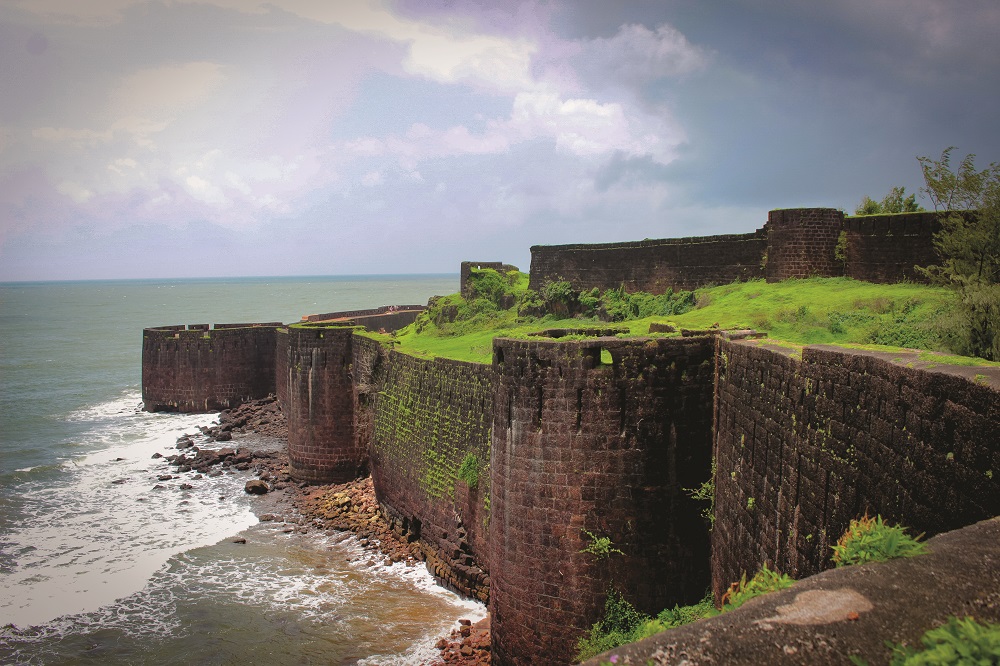
About Vijaydurag Fort:
Chhatrapati Shivaji Maharaj was India’s greatest king, and his reign was known as the Golden Age of the Maratha Empire. Many forts were built during this period. Some of these forts are marine forts. They played an essential role in the Maratha Empire. The Vijaydurg Fort is one such fort. Chhatrapati Shivaji revamped it. Presently, it is one of the crucial tourist attractions in the Sindhudurg district.
Once a marine fort, it was later connected to the mainland via a road. The sea surrounds it on its three sides. It is thought to become one of the most impenetrable fortifications ever built. Hence, the name “Eastern Gibraltar.”
It is located on the Arabian Sea shore in Sindhudurg’s Devgad Taluk.
The earliest fort on the Sindhudurg coast, Vijaydurg (also known as Viziadurg), Raja Bhoja II of the Shilahar dynasty erected it (building period 1193-1205), and Shivaji Maharaj rebuilt it.
The fort used to be 5 acres in size and was encircled on all sides by water. The eastern trench was recovered over time, and a road was built on top of it. Presently the area of the fort is about 17 acres and is surrounded by the Arabian Sea on three sides. Shivaji Maharaj extended the size of the defense by constructing three walls on the eastern side, each 36 meters high. He also built 20 bastions.
According to tradition, that’s one of only two Maratha forts whereby Shivaji Maharaj personally raised the saffron flag. Torna is the other fort.
Genealogy:
The Waghotan/Kharepatan stream, which is 40 kilometers long, is one of its locational assets. The creek’s shallow water prevents large vessels from entering. Maratha vessels may also be moored in this stream while remaining unseen from the sea. It is a protected historical site.
Location:
The fort of Vijaydurg is located near the point of the peninsular area of Vijaydurg in the Devgad Taluka of Sindhudurg district. This is one of the many coastal forts that dot Maharashtra’s western coastline. It is surrounded on all four sides by water but is connected to the land by a minor road. Local fishers still use the fort’s natural harbor, which is next to the defense.
History Vijaydurg Fort:
In 1653 Shivaji Maharaj captured this fort from Adil Shah of Bijapur and renamed it “Vijay Durg.” The defense’s original name was “Gheria,” and the initial fortress appears to have been built around 1200 during Raja Bhoj II’s reign. Shivaji Maharaj constructed Vijaydurg as an essential base for Maratha warships.
Maratha Empire looked to be in decline after the death of Shivaji Maharaj In 1680, when his son and successor Chhatrapati Sambhaji Maharaj was captured by Mughal Emperor Aurangzeb and brutally tortured to end on March 21, 1689. The Mughals took control of the fort of Raigad later that year. Shambhaji and his baby son Shahu, as well as a large number of others, were apprehended and held like federal inmates.
After that, the Maratha Empire was taken over by Shivaji Maharaj’s second wife’s son, Raja Ram. They fought back against the Mughals, inspired by Shambhaji’s courageous sacrifice. Kanhoji Angre alias Conajee Angria became the admiral of the Marathas’ naval army during his rule. Kanhoji established Vijaydurg as the capital of his coastal domain in 1698.
Raja Ram died in the year 1700. Tara Bai, Raja Ram’s courageous widow, seized leadership of the Maratha Empire. From 1700 until 1707, Tara Bai conducted victorious operations against the Mughals, putting her newborn son on the Maratha throne as “Shivaji II.” Taking advantage of the shame of Shivaji Maharaj’s ruling house, Kanhoji Angre became the most “Powerful and independent Naval Chief of West coast of India.” Tarabai gave Kanhoji the title of Sarkhel (Admiral). Kanhoji Angre was formerly the ruler of the whole coast, stretching from Bombay (now Mumbai) to Vengurla.
Shahu was freed from the Mughal captivity when Aurangzeb died in 1707. He called Tarabai and her son’s claim to the Maratha crown into question. The Marathas were split, but in 1713, Shahu took the throne when Chhatrapati and Tarabai were relegated to a tiny region of Kolhapur under the name of his son Shivaji II. Rajas Bai, her husband’s second wife, overthrew her and imprisoned her till her death.
In the same year, Shahuji dispatched Balaji Vishvanath, his Peshwa (Prime Minister), from Satara to negotiate with Kanhoji Angre. Kanhoji agreed to pledge his allegiance to Satara and abandon his previous devotion to Tarabai. Kanhoji was given twenty-six forts and fortified locations with their dependent villages to confirm his leadership of the Maratha fleet.
Chhatrapati’s death and Peshwa’s ascent:
On the Sindhudurg shore, Vijaydurg is considered to be the oldest fort. It was also known as “Eastern Gibraltar” before independence. This is due to the defense’s near impossibility to overcome. It resisted many British and Dutch naval attacks under the command of Kanhoji Angre. Kanhoji Angre died on July 4, 1729, and the Angres clan lost possession of the fort in 1756 when the Peshwa-British Alliance conquered them. In 1818, the British Empire had complete control over Vijaydurg.
Following Kanhoji Angre’s death, Sarfoji and Sambhaji each had a brief reign. manaji and Tulaji, two brothers, began battling for the Angre kingdom. Nanasaheb Peshwe had intervened in Manaji and Tulagi’s quarrels. Manaji in the north at Kulaba and Tulagi in the south at Vijaydurg was established due to this. Tulagi Angre was chosen as the Sarkhel (Admiral) of the Maratha Navy by Chhatrapati Shahu. This was against Nanasaheb Peshwa’s wishes.