
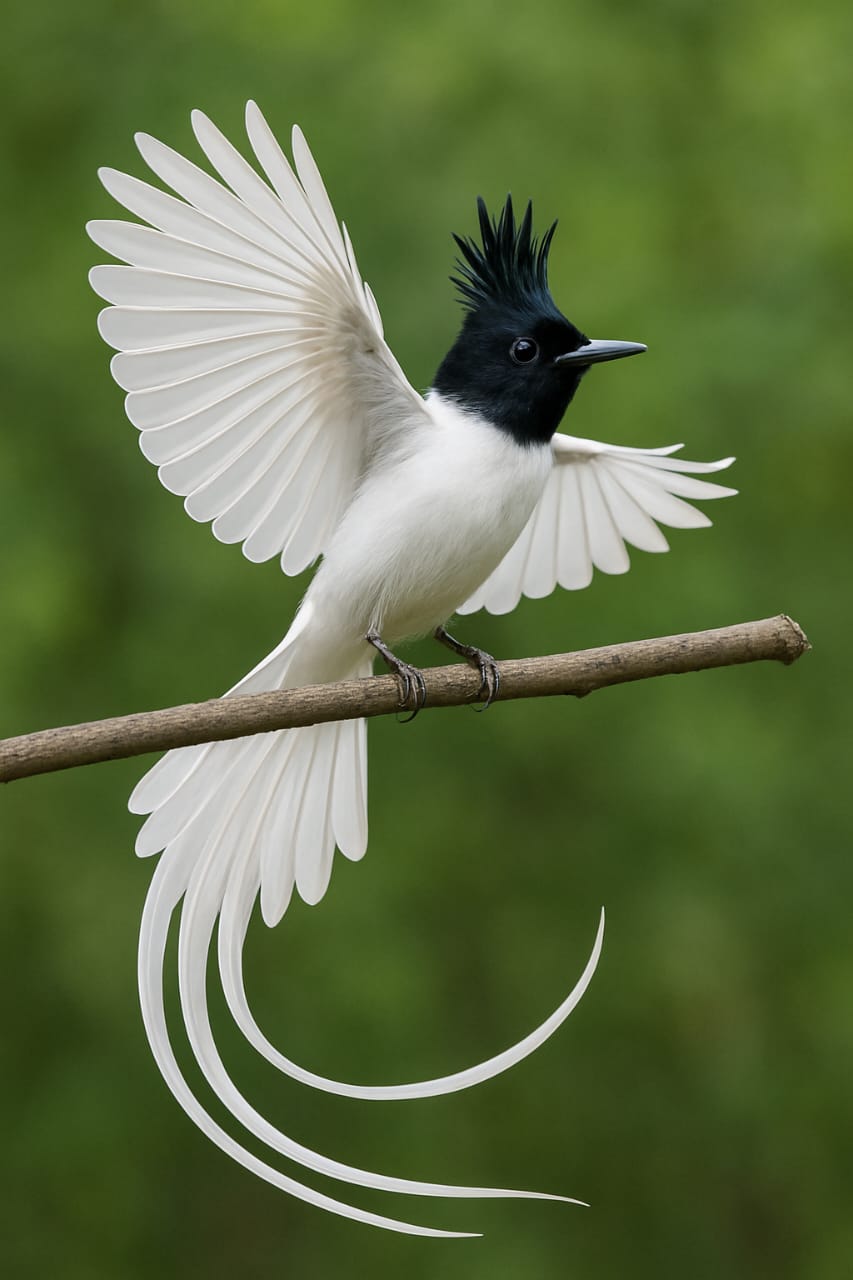
Indian Paradise Flycatcher The Glam King — My First Magical Sighting at Mukund Valley
If you have ever dreamed of seeing a bird that looks straight out of paradise, the Indian Paradise Flycatcher is that dream come alive. I experienced this magic for the first time at Mukund Valley, Ambajogai, and it became one of the most unforgettable wildlife moments of my life.
In this blog, I will share my personal story and everything you need to know about this stunning bird often called the white Indian Paradise Flycatcher or Dudhraj.
My First Encounter with the Indian Paradise Flycatcher at Mukund Valley
It happened on a quiet morning in Mukund Valley. As I walked through the trail, I saw a sudden flash of white gliding between the trees. At first, I thought it was a falling leaf shining in sunlight — until the “leaf” flew back in an elegant curve.
And there he was.
A fully mature white male Indian Paradise Flycatcher, known for its long ribbon-like tail and blue-black crest. His tail flowed like silk, and his bright white feathers glowed against the green forest backdrop. The soft blue ring around his eyes made him look almost royal.
This is the moment birdwatchers call the “Flash Dance of the Glam King.”
And trust me — it truly feels like a dance.
Is the Indian Paradise Flycatcher Rare? The Truth Behind Its “Rarity”
Many people ask, “Is the Indian Paradise Flycatcher rare?”
Here’s the clear answer:
Not globally rare
- Classified as Least Concern (IUCN)
- Found across India, Nepal, Pakistan, Sri Lanka, and Southeast Asia
But the white morph male feels rare
The pure white male, with long tail streamers, creates a perception of rarity because:
- He is shy and stays in dense forests
- Photogenic sightings are less common
- His movement is extremely graceful — making every sighting feel magical
- In regions like Bhutan and Central Asia, he is actually uncommon or rare
Rare morphs exist
Some extremely rare Indian Paradise Flycatchers show mixed white and rufous colors — highly prized by birders.
So, while the species isn’t endangered, seeing the white Glam King in good light is a special moment, especially in birding hotspots like Mukund Valley.

Why the Indian Paradise Flycatcher Is Called the “Glam King”
The nickname comes from its dramatic style:
Key characteristics of the male “Glam King”:
- Deep blue-black head and crest
- Bright white or rufous body
- Long, flowing tail streamers up to 30 cm
- Hypnotic aerial courtship dance
- Blue eye-ring that gives a royal look
When the white male flies, the tail floats behind him like long satin ribbons — making him one of the most beautiful birds in India.
This is why wildlife photographers, including me, often describe him as the king of glamour in the bird world.
Habitat: Where You Can Spot the Indian Paradise Flycatcher
The species lives in:
- Deciduous forests
- Evergreen forests
- Mangroves
- Green urban patches
- Riverbanks and valleys (like Mukund Valley)
These birds prefer dense canopies, which makes spotting them a bit challenging but incredibly rewarding.
you will be also like Devkund Waterfalls 2025 A Hidden Paradise in Maharashtra
Behavior, Migration & Lifestyle of the Paradise Flycatcher
-
Skilled Aerial Hunters
They catch insects mid-air — grasshoppers, moths, butterflies, beetles — without landing on the ground.
-
Migratory Experts
Northern populations migrate south during winter using:
- Magnetoreception (ability to sense Earth’s magnetic field)
- Long-distance night flights
-
Color Transformation
- Females & juveniles = rufous, short tails
- Males (age 2–4 years) = grow long tails
- Some turn fully white; some stay rufous
-
Beautiful Nesting Habits
- Monogamous during mating season
- Build neat cup-shaped nests
- Use spider webs, bark strips, and plant fibers
Cultural Name: Dudhraj — The Milk King of Indian Forests
In Hindi, “Dudhraj” means Milk King, referring to the pure white plumage of the adult male.
It is also called Shah Bulbul, another royal name fitting for its majestic looks.
The Indian Paradise Flycatcher is the state bird of Madhya Pradesh.
Threats & Conservation: Why This Bird Needs Protection
Although not endangered today, the species faces threats:
- Habitat loss
- Deforestation
- Urban expansion
- Fragmented nesting areas
- Pollution in urban forests
Conservation programs like Rewild for Wildlife aim to restore habitats so species like the Flycatcher can thrive.
Final Thoughts: A Moment That Lives in My Heart Forever
Seeing the Indian Paradise Flycatcher at Mukund Valley, Ambajogai was one of the most surreal moments of my life. The elegant white body, the long floating tail, the flash dance between the trees — it felt like nature paused to show me something sacred.
If you ever get the chance to spot this bird, especially the white male, consider it a blessing.
The Glam King doesn’t perform for everyone — but when he does, the memory stays forever.


