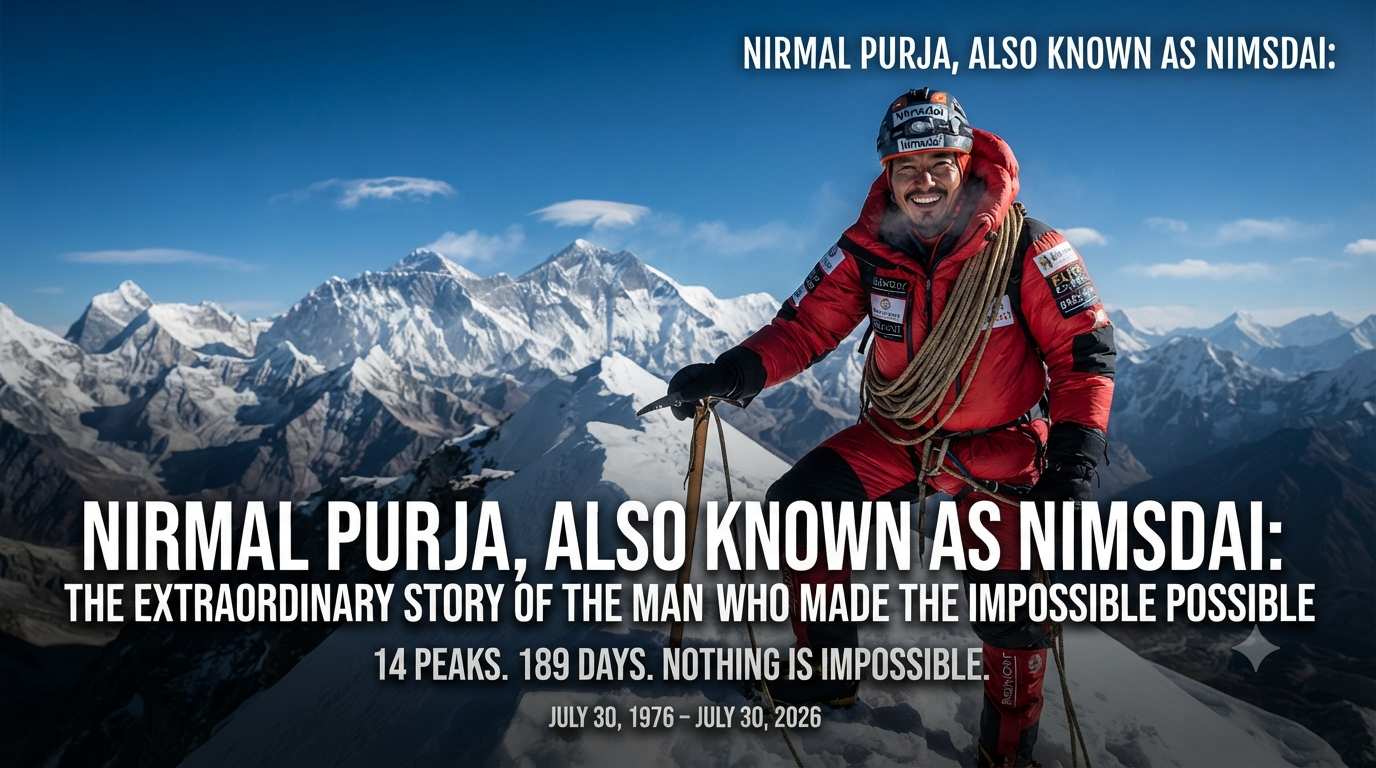
The Extraordinary Story of the Man Who Made the Impossible Possible – Nirmal Purja
There are some people who climb mountains.
And then there are people who make us look at mountains differently.
Nirmal “Nims” Purja was one of those people.
To millions around the world, he became known as Nimsdai—the charismatic Nepali mountaineer who seemed to move through the world’s highest mountains with an unusual combination of speed, confidence, military discipline and sheer determination.
But if you only remember him as the man who climbed all 14 of the world’s 8,000-metre mountains in six months and six days, you are remembering only one part of the story.
His life began far away from the spotlight.
It passed through rural Nepal, the Gurkhas, Britain’s elite Special Boat Service, the Himalayas, the world’s most dangerous peaks, a seemingly impossible mountaineering project, a Netflix documentary, record-breaking expeditions and, eventually, a final expedition on Broad Peak.
On July 30, 2026, Nirmal Purja died in an avalanche on Broad Peak in Pakistan at the age of 43. His death brought a tragic end to the life of one of the most recognisable figures in modern high-altitude mountaineering.
But perhaps the most important part of his story is not how he died.
It is how he lived.
Who was Nirmal Purja, also known as Nimsdai?
Nirmal Purja was a Nepali-born mountaineer, former Gurkha soldier and former member of Britain’s elite Special Boat Service.
He became internationally famous after completing what he called Project Possible: climbing all 14 mountains above 8,000 metres in just six months and six days.
These mountains are often called the world’s “Death Zone” peaks because above 8,000 metres, the human body struggles to survive for long periods.
Before Purja, climbing all 14 eight-thousanders was already considered one of mountaineering’s greatest achievements.
The previous record was measured in years.
Purja wanted to do it in months.
And that is where the Nimsdai story really begins.
A boy from Nepal who never started with a mountain
One of the most fascinating things about Nirmal Purja is that his childhood did not look like the beginning of a mountaineering legend.
He was born in Nepal and spent much of his early life in the Chitwan region, in the country’s southern plains rather than high in the Himalayas.
According to accounts of his early life, his family lived modestly. His father was a Gurkha soldier, and military service became a major part of the family’s story.
Nimsdai eventually followed that path.
In 2003, he joined the Brigade of Gurkhas.
Six years later, he was accepted into the UK’s elite Special Boat Service, commonly known as the SBS. He spent years developing the physical toughness, discipline and mental resilience that would later become central to his mountaineering career.
This part of his life is important because mountaineering did not create Nimsdai’s mindset.
The mountains gave that mindset a new battlefield.
You will be also like Our Latest Blog :- The Ultimate Kalavantin Durg Trek Guide: Route, Safety & Tips
From soldier to mountaineer
Imagine spending years training for situations where fear cannot be allowed to control your decisions.
Then imagine taking that mentality into an environment where one wrong decision can cost your life.
That was the transition Nirmal Purja eventually made.
His mountaineering journey developed while he was still serving in the military.
He began climbing peaks in Nepal, including Lobuche East and Ama Dablam. In 2014, he climbed Dhaulagiri, his first 8,000-metre mountain.
Something changed after that.
He discovered that the skills developed through military service could translate into the mountains.
Speed.
Discipline.
Planning.
Teamwork.
Decision-making under pressure.
And perhaps most importantly, the ability to keep moving when your mind is telling you to stop.
The idea that sounded impossible
In 2019, Nimsdai announced a project that made the mountaineering world stop and look.
He wanted to climb all 14 of the world’s mountains above 8,000 metres in seven months.
There are only 14 of these mountains on Earth.
They include Everest, K2, Kangchenjunga, Lhotse, Makalu, Cho Oyu, Dhaulagiri, Manaslu, Nanga Parbat, Annapurna, Gasherbrum I, Broad Peak, Gasherbrum II and Shishapangma.
At the time, the existing record was almost eight years.
Purja wanted seven months.
People questioned whether it was possible.
He took those doubts and turned them into the name of the project:
Project Possible.
Guinness World Records records that he ultimately completed the 14 peaks in six months, six days—189 days.
The name was no longer a motivational slogan.
It had become history.
Project Possible: 14 mountains in 189 days
The numbers are difficult to understand until you stop and imagine what they actually mean.
This was not one mountain.
It was fourteen.
Fourteen expeditions.
Fourteen enormous logistical problems.
Fourteen mountains with different weather patterns, terrain, climbing routes and risks.
And all of this had to happen within a period in which even one major delay could destroy the entire schedule.
Nimsdai started with Annapurna on April 23, 2019.
Then came Dhaulagiri.
Kangchenjunga.
Everest.
Lhotse.
Makalu.
The expedition then moved into Pakistan for Nanga Parbat, Gasherbrum I, Gasherbrum II, K2 and Broad Peak.
Then back toward the Himalayas for Cho Oyu and Manaslu.
Finally, on October 29, 2019, he reached the summit of Shishapangma.
Project Possible was complete.
The official Nimsdai record lists all 14 summits and dates, ending with Shishapangma on October 29, 2019.
Six months.
Six days.
Fourteen mountains.
A record that had once seemed almost unthinkable.
Why the 14 Peaks achievement was so extraordinary
It is easy to write:
“Nirmal Purja climbed 14 peaks in six months.”
But that sentence hides the real story.
At 8,000 metres, the environment itself becomes an enemy.
The body struggles to acclimatise.
Oxygen becomes scarce.
Weather can change rapidly.
Fatigue accumulates.
Decision-making becomes harder.
And rescue can become extremely difficult.
That is why these mountains are often described as the “Death Zone.”
A climber is not simply fighting the mountain.
They are fighting altitude, cold, exhaustion, weather, logistics and their own biological limitations.
Nimsdai’s approach was different from the traditional idea of spending a long period on each mountain.
He pushed a faster, highly organised style of high-altitude climbing that later became associated with #NIMSSTYLE. His official profile describes his approach as a fast-track method to climbing the world’s highest peaks.
The Everest and Lhotse double
One of the most remarkable moments in Project Possible came on May 22, 2019.
Nimsdai summited Everest and Lhotse on the same day.
The two mountains are neighbouring giants in the Himalayas.
His official record lists his Everest and Lhotse summits on May 22, followed by Makalu just two days later.
That is the kind of sequence that explains why people began paying attention to him not simply as another mountaineer, but as someone changing the idea of what was possible at high altitude.
K2: The mountain that had its own chapter
If Everest is the mountain most people know, K2 is often treated very differently by climbers.
It is the second-highest mountain on Earth, but its reputation for technical difficulty and dangerous conditions is legendary.
And then came another historic chapter in Nimsdai’s life.
On January 16, 2021, Nirmal Purja was part of the all-Nepali team that achieved the first winter ascent of K2.
K2 in winter was considered one of the last great problems in mountaineering.
The achievement was not just another line on Purja’s résumé.
It represented something bigger: a Nepali team standing together on the summit of one of the world’s most feared mountains during the harshest season.
Nimsdai and climbing without supplemental oxygen
Project Possible made Purja famous.
But his later climbing career added another dimension.
He began pursuing major ascents without supplemental oxygen.
According to Nimsdai’s official achievements page, he completed major no-oxygen milestones, including Everest, Lhotse and Kangchenjunga in 2022. He also established speed records involving these peaks.
In May 2022, he completed Kangchenjunga, Everest and Lhotse consecutively without supplemental oxygen in 8 days, 23 hours and 10 minutes, according to published records.
This is important because the oxygen question is central to discussions about high-altitude mountaineering.
Climbing above 8,000 metres is already extraordinary.
Doing it without supplemental oxygen adds another level of physiological difficulty.
The man behind the viral phrase: “Nothing Is Impossible”
For many people, Nimsdai became known through a simple message:
Nothing is impossible.
It became more than a phrase associated with a mountaineer.
It became his personal philosophy.
But there is an interesting difference between saying something is possible and building an actual plan to make it possible.
Purja’s story was never simply about motivation.
Project Possible required logistics.
Money.
Sponsors.
Weather windows.
Climbing teams.
Equipment.
Travel.
Planning.
Communication.
Media management.
And the ability to recover quickly and move to the next challenge.
In fact, Nimsdai later explained that managing the overall project—including fundraising, social media, funding and other dynamics—was one of the biggest challenges of the entire mission.
That is an important lesson hidden inside the adventure.
Dreams may begin with imagination.
But impossible-looking goals become achievable through systems.
Nimsdai’s relationship with his team
One mistake people can make when watching a documentary about a record-breaking climber is to imagine a lone hero.
But high-altitude mountaineering is rarely a one-person story.
Project Possible depended heavily on a team of Nepalese climbers and Sherpas.
The Netflix documentary 14 Peaks: Nothing Is Impossible makes this especially visible.
The film follows Purja and his team through extreme weather, difficult decisions, funding challenges and the emotional pressure surrounding his mother’s illness. Netflix describes the documentary as the story of Purja’s attempt to climb all 14 eight-thousanders in seven months.
That human element matters.
Because behind the photographs of one person standing on a summit are dozens of people who helped make that photograph possible.
Nimsdai became a global name through Netflix
In 2021, Nimsdai’s story reached an audience far beyond the mountaineering world.
The Netflix documentary 14 Peaks: Nothing Is Impossible introduced his journey to millions of viewers.
The documentary was directed and produced by Torquil Jones, with Jimmy Chin and Elizabeth Chai Vasarhelyi among the executive producers.
The film did something important for Purja’s legacy.
It turned numbers into a story.
Instead of simply hearing:
“Someone climbed 14 mountains in 189 days.”
Viewers could see the fear.
The exhaustion.
The arguments.
The weather.
The uncertainty.
The family pressure.
The celebration.
And the personalities behind the expedition.
For many people who had never heard the name Nirmal Purja, Netflix became the introduction to Nimsdai.
Beyond Possible: the book
If the documentary showed Nimsdai’s journey visually, his autobiography gave readers another way to understand it.
His book is titled:
Beyond Possible: One Soldier, Fourteen Peaks – My Life in the Death Zone.
The book traces his transformation from Gurkha and UK Special Forces soldier into one of the world’s most famous high-altitude mountaineers. It was published by Hodder & Stoughton and has also been released in other editions.
The title itself explains the philosophy.
He did not simply want to tell people what he had achieved.
He wanted people to question the limits they had already accepted.
That is why his story resonated beyond mountaineering.
An entrepreneur can relate to it.
An athlete can relate to it.
A student can relate to it.
Someone starting again at 30 can relate to it.
Someone who has been told “you can’t do that” can relate to it.
Nimsdai after Project Possible
Many people would have stopped after Project Possible.
For Purja, it was almost the beginning of another chapter.
He developed his guiding and expedition business, built a public identity around high-altitude expertise, and launched projects connected with mountaineering.
His official biography describes his transition from Special Forces soldier to mountaineer and guide, with an emphasis on sharing his knowledge and helping others pursue high-altitude goals.
He also established the Nimsdai Foundation, with projects connected to mountain communities, environmental protection and education. The foundation’s initiatives included mountain clean-up efforts and support for porters and veterans.
This part of his story is easy to overlook because the records are more dramatic.
But perhaps it is just as important.
A person’s legacy is not only what they personally accomplish.
It is what they leave behind for others.
The Hat-Trick Challenge
And then came another seemingly impossible goal.
In 2025, Purja announced the Hat-Trick Challenge.
The ambition was extraordinary:
To complete the world’s 14 eight-thousanders for a third time, while also completing the Seven Summits for a third time.
The project was described by Nimsdai’s organisation as a world-first ambition.
By September 2025, the project was still underway, with four 8,000-metre mountains remaining for the 14 Peaks portion. The project also had a charitable purpose, with fundraising directed toward the Nimsdai Foundation.
Once again, the pattern was familiar.
A goal that sounded almost absurd.
A plan.
A team.
A mountain.
And Nimsdai moving toward it.
Broad Peak: the final mountain chapter
The most difficult part of telling Nirmal Purja’s story today is that we know how it ended.
On July 30, 2026, Purja was on Broad Peak in Pakistan.
Broad Peak rises to approximately 8,051 metres and is the world’s 12th-highest mountain.
An avalanche struck the expedition.
Nirmal “Nimsdai” Purja was among ten climbers and mountaineers who died. Rescue and recovery operations were complicated by the altitude, terrain and weather.
He was 43.
The man who had spent years entering some of the most dangerous environments on Earth had lost his life in one of them.
It is tempting to describe his final climb as the end of a heroic adventure.
But real life is more complicated than that.
Mountains do not care about reputation.
They do not care about world records.
They do not care how many times someone has survived before.
That may be one of the hardest truths in mountaineering.
Experience can reduce risk.
It can never eliminate nature’s unpredictability.
Nirmal Purja’s death and the end of an era
The news of Purja’s death travelled around the world.
For Nepal, Britain and the international mountaineering community, it was the loss of a remarkable figure.
Reuters reported tributes from Nepali Prime Minister Balendra Shah and UK Defence Minister Wes Streeting, while climbers remembered Purja as a colourful and influential figure in modern high-altitude climbing.
His influence extended beyond the records.
He helped put Nepalese climbers at the centre of international mountaineering stories.
He demonstrated that the strongest mountaineering stories did not always have to be led by Western climbers.
He made Nepalese teams visible.
He brought social media into the high-altitude conversation.
He turned expeditions into stories people around the world could follow.
And he showed that a climber could be simultaneously an athlete, entrepreneur, filmmaker, guide and public personality.
What made Nimsdai different?
There have been many great mountaineers.
So why did Nirmal Purja become such a global phenomenon?
Perhaps it was the combination.
Military background.
Nepalese roots.
Extreme physical ability.
Speed.
Confidence.
Storytelling.
Social media.
Business sense.
A willingness to challenge established ideas.
And above all, a very clear personal philosophy.
He wanted people to question the word “impossible.”
That philosophy made him inspiring to people who had never touched a climbing rope.
Nirmal Purja’s greatest achievements
If someone searches for “Nirmal Purja achievements”, these are among the most important chapters to remember:
-
All 14 eight-thousanders in 189 days
His defining achievement was completing all 14 of the world’s 8,000-metre mountains in six months and six days during Project Possible.
-
First winter ascent of K2
Purja was part of the all-Nepali team that achieved K2’s first winter ascent in January 2021.
-
Major no-oxygen records
He later established remarkable records climbing major 8,000-metre peaks without supplemental oxygen.
-
Everest-Lhotse speed record
His official profile highlights the fastest Everest-to-Lhotse double, completed in 10 hours and 15 minutes during his record-setting career.
-
14 Peaks documentary
His story became the Netflix documentary 14 Peaks: Nothing Is Impossible, bringing high-altitude mountaineering to a global mainstream audience.
-
Beyond Possible
His autobiography gave readers a personal account of his military career, mountaineering journey and Project Possible.
Nirmal Purja’s legacy is bigger than a record
Records eventually get broken.
Someone may climb faster.
Someone may develop a different strategy.
Someone may eventually complete an even more ambitious project.
But Nimsdai’s impact cannot be measured only by a stopwatch.
His real legacy may be the change in mindset he represented.
Before Project Possible, people looked at the 14 eight-thousanders as an achievement measured in years.
Purja looked at the same mountains and asked a different question:
What if it could be done in months?
That is the essence of innovation.
You don’t always win by becoming better at the existing game.
Sometimes you win by questioning the rules of the game.
What Nimsdai can teach us about life
You don’t need to climb Everest to learn something from Nirmal Purja.
His story contains lessons that apply to ordinary life.
Dream beyond your current identity
Purja was not born as “Nimsdai the mountaineer.”
He was a child in Nepal.
Then a soldier.
Then a Special Forces operator.
Then a mountaineer.
Then a record holder.
Then a guide and entrepreneur.
Your current identity does not necessarily determine your final chapter.
Turn impossible goals into projects
“Climb 14 mountains” is a dream.
“Climb this mountain by this date, arrange this team, secure this funding, prepare this equipment and move to the next peak” is a project.
That difference matters.
Speed means nothing without preparation
Nimsdai became famous for speed.
But speed was built on preparation.
You cannot simply decide to move quickly at 8,000 metres.
You need experience, fitness, logistics, route knowledge, teamwork and judgment.
The same is true in business and life.
Your team matters
The summit photograph may show one person.
The achievement usually belongs to many.
Courage is not the absence of fear
Courage is continuing to make decisions while fear exists.
That is one of the strongest lessons hidden in the mountains.
Why people still search for Nirmal Purja
After his death, searches for Nirmal Purja are likely to remain connected to several different intentions.
Some people will search:
Who was Nirmal Purja?
Others will ask:
How did Nirmal Purja climb all 14 peaks?
Some will search:
Nirmal Purja death
Others will want to know:
How old was Nimsdai?
Who was Nirmal Purja’s wife?
What happened to Nimsdai on Broad Peak?
What is Project Possible?
Where can I watch 14 Peaks?
What is Nirmal Purja’s book?
How many mountains did Nimsdai climb?
And many will simply type:
Nimsdai
These are not completely separate stories.
They are different doors into the same story.
And that is why an article about Nirmal Purja should not be written like a dry biography.
People aren’t only searching for dates.
They are searching for the person behind the achievement.
14 Peaks: Nothing Is Impossible — the film that introduced Nimsdai to the world
If you have never heard Nirmal Purja speak about his journey, 14 Peaks: Nothing Is Impossible is one of the best places to start.
The documentary follows his attempt to climb all 14 eight-thousanders in seven months and captures the people, danger, pressure and emotion surrounding the mission.
Netflix currently lists the film as a documentary about Nimsdai’s attempt to climb all 14 of the world’s 8,000-metre peaks.
But there is an important difference between watching the documentary and understanding the whole story.
The film shows the expedition.
His autobiography, Beyond Possible, gives additional context.
His wider career—from the Gurkhas to the SBS, from Project Possible to K2, from no-oxygen records to the Hat-Trick Challenge—shows that Project Possible was not an isolated event.
It was the central chapter in a much larger life.
The final lesson from Nimsdai
Perhaps the most powerful way to remember Nirmal Purja is not as a man who conquered mountains.
Mountains cannot really be conquered.
They can be climbed.
They can be respected.
They can be survived.
And sometimes, tragically, they can take a life.
Nimsdai spent his life returning to them anyway.
He climbed when people told him his plans were impossible.
He built a team around enormous goals.
He turned military discipline into mountaineering performance.
He transformed a record into a global story.
He turned his experiences into a book and a documentary.
He built organisations around the mountains.
And even after achieving what many would consider the ultimate mountaineering goal, he continued searching for another challenge.
His final project was unfinished.
His final mountain did not give him the summit he wanted.
But perhaps that is not the right way to measure his life.
Because the real summit was reached long before Broad Peak.
It was reached the moment a young man from Nepal looked at a life that could have followed a predictable path and decided to ask a much bigger question:
What is actually possible?
That question became Project Possible.
Project Possible became history.
History became a documentary.
The documentary introduced Nimsdai to millions.
And now, after his death, the question continues.
What does it mean to live beyond the limits other people set for you?
Nirmal Purja spent much of his life trying to answer it.
He did not live a quiet life.
He lived at the edge.
And perhaps that is why his story will continue to travel far beyond the mountains.
Nirmal “Nimsdai” Purja may be gone, but the question he spent his life asking remains:
What if the impossible is only something nobody has done yet?