
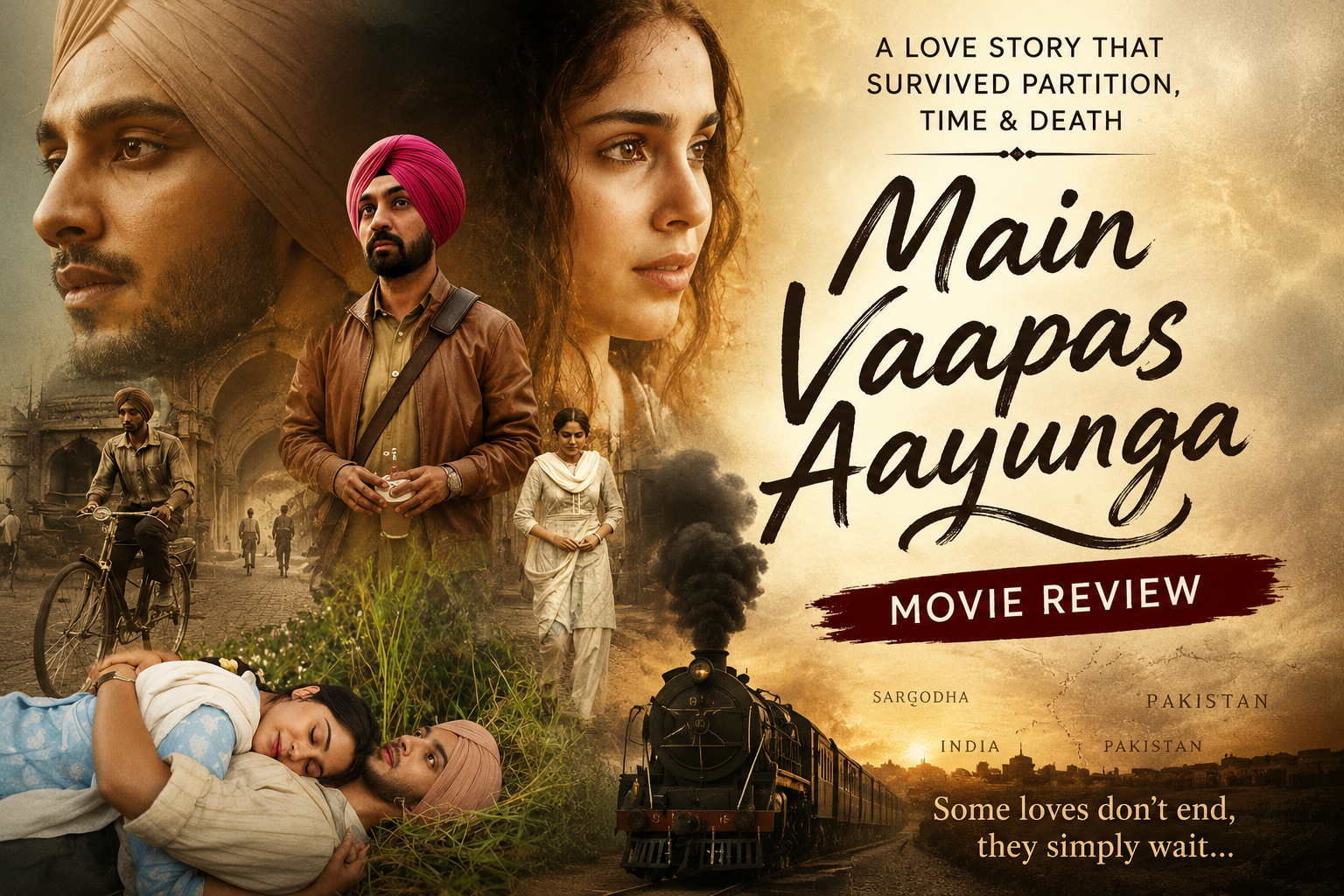
Main Vaapas Aaunga Movie Review: Some Love Stories Never End, They Simply Wait
There are films that entertain you.
There are films that impress you.
And then there are films that quietly sit beside you after the credits roll, refusing to leave.
For me, Main Vaapas Aaunga was one of those films.
When I entered the theatre, I thought I was going to watch a Partition drama.
When I left the theatre, I realized I had witnessed something much deeper.
A story about love.
A story about memory.
A story about waiting.
And perhaps most importantly, a story about how some people leave our lives, but never leave our hearts.
The moment the film ended, I kept remembering Piyush Mishra’s legendary song Husna.
Not because the stories are identical.
But because both carry the same pain.
The pain of borders.
The pain of separation.
The pain of two people who loved each other but were forced apart by circumstances larger than themselves.
And somewhere between Husna and Main Vaapas Aaunga, I found myself thinking about a question that has no answer:
How far can love travel?
Can it survive distance?
Can it survive time?
Can it survive history?
Can it survive an entire lifetime?
Imtiaz Ali’s latest film attempts to answer that question.
And the answer is heartbreaking.
You May Also Like to Read
Krishnavataram Part 1 Review: The Heart (Hridayam) and Its Most Heartbreaking Dialogue Moments
Main Vaapas Aaunga Movie Review: A Partition of Land. A Partition of Hearts.
Most films about the Partition of 1947 focus on politics.
Some focus on violence.
Some focus on religion.
Main Vaapas Aaunga chooses something different.
It focuses on people.
It focuses on the hearts that were broken when a line was drawn across a map.
History books tell us that India and Pakistan were divided.
But this film reminds us that millions of love stories were divided too.
Families were divided.
Friendships were divided.
Childhoods were divided.
Dreams were divided.
And in the middle of all that chaos stood ordinary people who simply wanted to live, love, and grow old together.
Keenu and Jiya are among those people.
Their story begins like every beautiful love story should.
With innocence.
With curiosity.
With stolen glances.
With smiles that last longer than conversations.
With the excitement of seeing someone and pretending not to notice them.
There is something magical about first love.
Especially in the old world.
No phones.
No social media.
No instant messages.
Just waiting.
Looking.
Hoping.
And cherishing every small moment.
Imtiaz Ali captures that feeling beautifully.
The world around Keenu and Jiya feels soft.
Gentle.
Hopeful.
The kind of world where love grows slowly and naturally.
A world that no longer exists.
And perhaps that’s why their love feels so pure.
Main Vaapas Aaunga Movie Review: When History Becomes the Villain
What makes Main Vaapas Aaunga special is that it doesn’t create a human villain.
There is no evil mastermind.
No single person responsible for the tragedy.
The villain is history itself.
The villain is hatred.
The villain is a border.
The villain is a decision that changed millions of lives forever.
One day Keenu and Jiya are dreaming about their future.
The next day they are fighting for survival.
The film constantly reminds us that ordinary people rarely start wars.
Yet they are always the ones who suffer the most.
The politicians make decisions.
The common people pay the price.
And nowhere is that truth more visible than during Partition.
The film’s greatest achievement is that it never turns into propaganda.
It never asks us to hate anyone.
Instead, it asks us to mourn everyone.
It asks us to remember that pain has no religion.
Tears have no religion.
Loss has no religion.
Love has no religion.
And that message feels incredibly relevant even today.
Main Vaapas Aaunga Movie Review: Naseeruddin Shah: The Soul of the Film
If Main Vaapas Aaunga works emotionally, a huge reason is Naseeruddin Shah.
This is not just acting.
This is emotional archaeology.
He plays a man whose body is dying but whose memories refuse to die.
A man trapped between the present and the past.
A man whose heart never truly left Sargodha.
Every expression carries decades of grief.
Every look carries unfinished conversations.
Every silence feels louder than words.
There is a sadness in his eyes that cannot be taught.
Only experienced.
And that is what makes the performance unforgettable.
As I watched him struggle to hold onto life, I wasn’t thinking about a character.
I was thinking about all those people who spent their entire lives carrying memories they never shared.
Memories that became wounds.
Wounds that became silence.
And silence that became inheritance.
Main Vaapas Aaunga Movie Review: The Love That Refused to Die
One of the most beautiful ideas in the film is that love does not always need presence.
Sometimes love survives through memory.
Sometimes love survives through hope.
Sometimes love survives through promises.
And sometimes love survives through waiting.
For seventy-eight years.
Think about that.
Seventy-eight years.
Entire generations are born and disappear within that period.
Cities change.
Governments change.
Technology changes.
The world changes.
But a feeling remains.
That idea sounds impossible.
Yet somehow Imtiaz Ali makes you believe it.
Because deep down, we all know there are people we never completely forget.
Some names stay with us forever.
Some moments stay with us forever.
Some versions of ourselves stay frozen in time.
And every now and then, they return.
Like an old song.
Like a forgotten fragrance.
Like a memory that suddenly appears without warning.
Main Vaapas Aaunga Movie Review: The Dialogue That Broke Me
There is one dialogue in the film that stayed with me long after the movie ended.
” ये प्यार भी ना ज़हर की तरह होता है, पता है?
इसकी एक भी बूंद अगर भीतर रह जाए ना,
तो ये आख़िरी समय में भी इंसान को चैन से मरने नहीं देता।
हम उसे उम्रभर बाँटते रहते हैं…
काम में,
अपने जुनून में,
अपने लोगों में…
फिर भी वह बचा रह जाता है।
कम नहीं होता। रह जाता है |
.”
For me, this dialogue explains the entire film.
Love is not something we move on from.
Love transforms.
It changes shape.
It hides itself inside our work.
Inside our dreams.
Inside our ambitions.
Inside the people we care about.
But some part always remains.
Waiting.
Breathing.
Existing.
And perhaps that is why Keenu could never let go.
Because some loves do not end.
They become part of your identity.
Why Husna Kept Playing In My Mind
Throughout the film, I kept hearing Husna in my head.
The lyrics.
The pain.
The longing.
The separation.
The impossible distance between two hearts.
Piyush Mishra’s masterpiece has always been about more than romance.
It is about borders.
Memory.
History.
And longing.
The same emotions flow through Main Vaapas Aaunga.
Both stories remind us that maps can divide nations.
But they cannot erase love.
They cannot erase memories.
And they certainly cannot erase hope.
Main Vaapas Aaunga Movie Review: More Than a Love Story
What surprised me most was that the film is not actually about romance.
At least not entirely.
It is about memory.
It is about generational trauma.
It is about the stories our grandparents never told us.
It is about the pain they carried silently so that future generations could live peacefully.
The film asks an uncomfortable question:
What happens when trauma is buried instead of healed?
The answer is simple.
It survives.
And that is exactly what happened after Partition.
The older generation swallowed the poison.
The younger generation inherited the scars.
Main Vaapas Aaunga explores this idea with remarkable sensitivity.
Main Vaapas Aaunga Movie Review: Final Thoughts
Main Vaapas Aaunga is not a perfect film.
Its first half is slower than many viewers may prefer.
Some subplots could have been tighter.
Some moments repeat themselves.
But none of those flaws matter once the film reaches its emotional destination.
Because at its heart, this is a film about something universal.
The desire to return.
Return to a place.
Return to a memory.
Return to a person.
Return to a version of ourselves that once knew pure love.
Imtiaz Ali has made many films about people searching for themselves.
This time he has made a film about a man searching for a promise.
And in doing so, he has given us one of the most emotional explorations of love, separation, and memory in recent years.
By the time the credits rolled, I was not thinking about India.
Or Pakistan.
Or Partition.
I was thinking about love.
The kind of love that survives distance.
The kind of love that survives decades.
The kind of love that survives history.
The kind of love that survives even death.
Because maybe some people never really leave us.
Maybe they simply wait.
And maybe, like Keenu,
we are all trying to go back somewhere.
⭐⭐⭐⭐⭐ 4.5/5
Main Vaapas Aaunga is not just a movie.
It is a reminder that the deepest borders are not drawn on maps.
They are drawn across hearts.


