
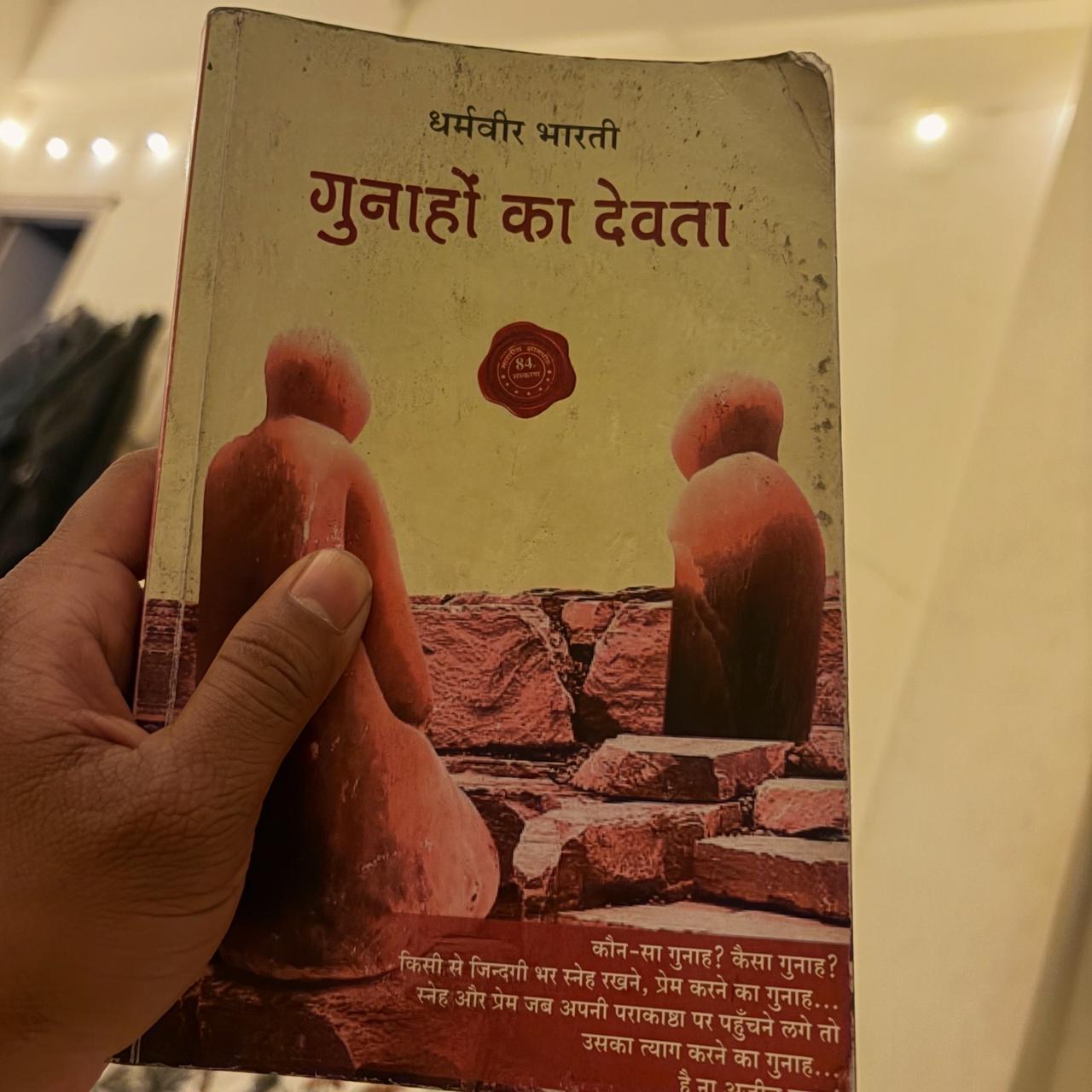
There are some books you read… and then there are books that quietly enter your soul. Gunahon Ka Devta Book is not just a novel—it is an emotional experience, a silent storm of love, sacrifice, and unspoken pain that lingers long after the last page.
I completed this book on 11th April, and honestly, it didn’t feel like I “finished” it. It felt like I left a part of myself behind in its world.
Written by Dharamvir Bharati, this timeless classic dives deep into the complexities of love that is never expressed, emotions that are never fulfilled, and relationships that are bound more by silence than words.
What is Gunahon Ka Devta About? (Summary with Emotional Depth)
At its core, Gunahon Ka Devta is the story of Chandar and Sudha—two souls deeply connected, yet painfully distant when it comes to love.
Chandar, a brilliant and disciplined student, shares a close bond with his mentor Dr. Shukla and his daughter Sudha. Their relationship begins with innocence, friendship, and comfort—but slowly transforms into something much deeper… something they both feel, yet never confess.
And that is where the tragedy begins.
“Kuch rishton ka naam nahi hota… par unki gehraai sabse zyada hoti hai.”
This line captures the entire essence of the novel.
The Silent Love Story of Chandar and Sudha
Unlike modern love stories filled with expression, confession, and closure—this one thrives on restraint and sacrifice.
Chandar believes in discipline, morality, and societal structure. He suppresses his love for Sudha, convincing himself that their relationship should remain “pure” and untouched by romantic desire.
But love doesn’t follow logic.
Sudha, on the other hand, trusts Chandar completely. She doesn’t question his decisions—even when they slowly start breaking her from within.
“Tum jo kahoge wahi karungi… kyunki tum galat ho hi nahi sakte.”
This is not just love. This is surrender.
The Turning Point – When Love Becomes Sacrifice
The most heartbreaking part of the novel is when Chandar encourages Sudha to marry someone else.
Yes, the man she loves… the man who loves her… becomes the reason she walks away.
Why?
Because Chandar believes that their love is not “right.” He chooses society over emotions, logic over heart, and ideals over reality.
“Insaan apne hi banaye hue niyamon ka gulaam ban jata hai.”
This moment is not just a plot twist—it’s an emotional collapse.
As a reader, you feel anger, frustration, helplessness… and yet, you understand Chandar. That’s the beauty of this story.
Sudha The Purest Form of Love
Sudha is not just a character—she is an emotion.
She represents a kind of love that is rare today:
- Selfless
- Trusting
- Unquestioning
- Painfully loyal
Even after marriage, even after distance, her love for Chandar doesn’t fade. It transforms into silent suffering.
“Pyaar sirf paane ka naam nahi hota… kabhi kabhi khona bhi pyaar hota hai.”
Her pain is not loud. It doesn’t scream. It quietly exists… and that makes it even more heartbreaking.
Chandar’s Inner Conflict is The Real “Gunah”
Why is Gunahon Ka Devta Called “Gunahon Ka Devta”? — A Story Behind the Title
Some titles don’t just name a book… they haunt you.
Gunahon Ka Devta is one of them.
When I first picked up this novel, the title itself felt strange—almost contradictory.
How can someone be a Devta (God) and still belong to Gunah (sin)?
But as I turned each page, lived each moment with Chandar and Sudha, I realized—
this title is not confusing… it is painfully accurate.
A Story That Begins with Purity
Chandar is not your typical flawed hero.
He is:
- Disciplined
- Intelligent
- Emotionally controlled
- Deeply respectful toward his mentor and society
In every possible way, he feels like a Devta—pure, ideal, someone who always does the “right thing.”
And then there is Sudha.
Innocent, loving, and completely devoted. Their bond is soft, unspoken, and deeply real.
They don’t confess love—but they live it in every small gesture.
It feels perfect.
It feels pure.
It feels… sacred.
When Love Becomes a Silent Crime
But then comes the moment where everything changes.
Chandar realizes that what he feels for Sudha is not just affection—it is love.
And instead of embracing it… he steps back.
Not because he doesn’t love her.
But because he believes loving her would somehow make their relationship “impure.”
And that is where the first “Gunah” (sin) is born.
The sin of denying your own truth.
He convinces himself that:
- Love should be controlled
- Emotions should be sacrificed
- Society’s structure matters more than personal happiness
And slowly, without realizing it…
he begins to destroy the very thing he was trying to protect.
The Biggest Mistake Disguised as Morality
The most heartbreaking part of the story is not separation.
It is Chandar himself becoming the reason for that separation.
He encourages Sudha to marry someone else.
Yes… the man she trusts the most, the man she silently loves,
is the one who pushes her away.
And Sudha?
She doesn’t question him.
She doesn’t fight.
She simply accepts.
Because her love is not demanding—it is surrendering.
The Moment That Defines the Title
There comes a point in the story where love is no longer hopeful—it becomes final, irreversible.
And in that moment, a line hits you with unbearable weight:
“Punarjanm sach hai ya jhooth!
agar jhoot hai to Chandar samjho tumne mujhe anant kaal ke liye kho diya hai.”
It doesn’t sound like anger.
It doesn’t even sound like complaint.
It sounds like eternity breaking into silence.
This is where you understand the title.
Chandar – A Devta in the World, A Sinner Within
To the outside world, Chandar remains:
- Ideal
- Respectable
- Morally strong
A Devta.
But inside?
He carries:
- Regret
- Guilt
- Emotional destruction
Because the truth is:
He didn’t commit a sin in the eyes of society
But he committed the deepest sin in the world of emotions
He loved… but chose not to accept it
He knew… but chose to stay silent
He had everything… and still let it go
The Real Meaning of “Gunahon Ka Devta”
The title is not about crime.
It is about contradiction.
It tells us:
- A person can look perfect outside
- Yet be completely broken inside
- A person can do everything “right”
- And still end up hurting the most important person in their life
Chandar becomes a Devta because of his ideals.
But he becomes a Gunahgaar (sinner) because of his decisions.
And that is why he is called:
“Gunahon Ka Devta” — The God of Sins
A Story That Reflects Us
When I finished this part of the story, I didn’t just think about Chandar.
I thought about us.
How many times do we:
- Stay silent when we should speak?
- Let go of something we truly want?
- Choose “what is right” over “what is real”?
And later… we live with it.
Famous quotes Heart-Touching Lines
Here are some of the most emotional and unforgettable lines from the book that truly define its soul:
“Main tumse pyaar karta hoon… par shayad isi liye tumhe paana nahi chahta.”
“Har insaan apni zindagi mein ek baar galti karta hai… par kuch log us galti ko kabhi sudhaar nahi paate.”
“Tum mere liye kya ho, ye main khud nahi samajh paaya… aur jab samjha, tab der ho chuki thi.”
“Zindagi mein sab kuch mil jata hai… bas waqt par samajh nahi aata.”
Each of these lines doesn’t just sound beautiful—they hurt. They make you pause, reflect, and feel.
Themes That Make This Gunahon Ka Devta Book Timeless
- Unspoken Love
This is not a love story of confession. It is a story of suppressed emotions.
- Sacrifice vs Happiness
Chandar sacrifices love for ideals—but was it worth it?
- Emotional Dependency
Sudha’s world revolves around Chandar—and that becomes her strength and weakness.
- Societal Pressure
The novel questions how much control society should have over personal emotions.
- Regret
The most powerful emotion in the book is not love—it is regret.
Why Gunahon Ka Devta Book Still Feels Relevant Today
Even though the gunahon ka devta book was written decades ago, its emotions are timeless.
In today’s world of fast relationships and quick breakups, this story reminds us:
- Love is not always about being together
- Sometimes, the deepest love remains incomplete
- And sometimes… the biggest mistakes are not actions, but inactions
You may not relate to the situations—but you will definitely relate to the emotions.
My Personal Reflection After Finishing the Gunahon Ka Devta Book (11th April)
When I closed the Gunahon ka devta book, there was silence.
Not the peaceful kind—but the heavy kind. The kind that makes you stare at nothing and think about everything.
I kept asking myself:
- Why didn’t Chandar just confess?
- Why did Sudha never question him?
- Why do we complicate love so much?
And then I realized—Gunahon ka devta story is not about them.
It’s about us.
We all have moments where we:
- Stay silent instead of speaking
- Choose logic over emotions
- Let go of something we actually wanted
And later… we live with it.
“Kuch kahaniyaan khatam nahi hoti… bas ruk jaati hain.”
Who Should Read Gunahon Ka Devta Book?
Gunahon ka devta book is perfect for:
- Readers who love emotional and psychological depth
- People who believe in old-school love
- Anyone who has experienced unspoken feelings
- Readers looking for Hindi literature classics
If you want a light, happy story—this is not for you.
But if you want something that will stay with you forever—this is a must-read.
Final Thoughts of Gunahon Ka Devta Book Summary
Gunahon Ka Devta is not just a book—it is a mirror.
It shows you what happens when:
- You don’t speak your heart
- You let fear control your decisions
- You choose “right” over “true”
And in the end, it leaves you with one haunting question:
“Kya sach mein har sahi faisla, sahi hota hai?”
You will be also like a best book extended version marathi award wining novel Babi hi Vat Ekatichi by Va. Pu. Kale.


